Meet the Maple Maker: Richardson Family Farm
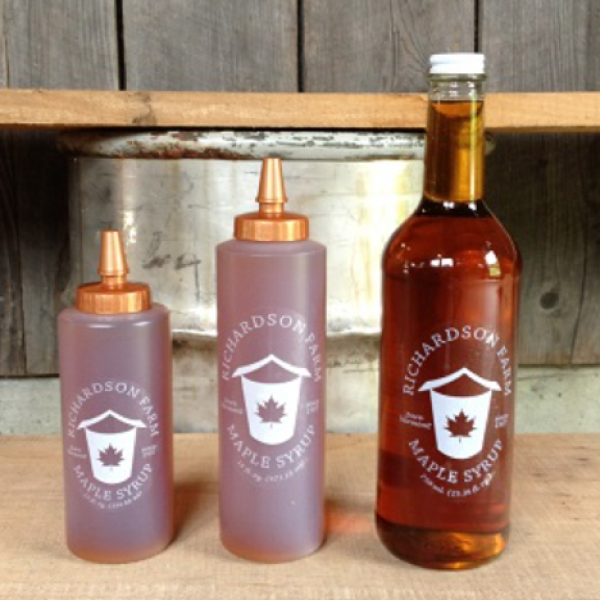
We stopped by Richardson Family Farm in Hartland, VT, a couple of sugar seasons ago and chatted with Reid, who has been helping out on the family farm during sugaring season since he was a kid. Richardson Farm Maple provides maple syrup to both our Woodstock and Waterbury locations.
Q. Can you give us a short history of your business? Is there a family component?
A. We have been in Hartland since 1905 when Great Grandparents James and Lexi Richardson moved up from Chester and purchased the farm. Grandparents Floyd and Veneita Richardson added acreage to the farm, as did their children. All generations have made maple syrup here, but it was brothers James and Gordon who really turned it into a business and tapped thousands of trees.
Today we tap just under 12,000 trees and all the sap from those trees runs downhill to our sugarhouse. We utilize the latest technology in the process of collecting and processing maple sap into syrup. That technology includes a vacuum system to collect the sap; reverse osmosis to remove water from the sap before we boil it; a wood-burning, gasifying arch to cook the syrup on; and a giant array of solar panels to provide all the electricity that we need to do the job. All the components have an eye towards efficiency and reduction of labor. Conveniently, they also reduce our carbon footprint.
Q. When do you start tapping? How many trees do you tap?
A. We started tapping in the last week of January. We have 11,600 taps.
Q. How many gallons of syrup are you projecting to produce?
A. I’m hoping to produce 6,000 gallons, but Mother Nature is in charge of that. We have made as much as 7,400 gallons and as little as 3,600 gallons from the same number of taps.
Q. Can you tell us about being Audubon certified as a bird-friendly habitat?
A. The designation is one that we have worked towards—without knowing—for a very long time. Our farm and forest land is in the state’s Use Value Appraisal program and is also conserved with the Upper Valley Land Trust. Both programs require a forest management plan to be in place. Within the forest management plan, goals need to be set by the landowners. Our primary goal has always been to maintain a sugarbush where limited cutting is done.
We have learned over the years that a monoculture (only one species of tree, in this case, maple) is not a healthy forest. While it sounds ideal, it is not very resilient. Forests with a diverse array of tree species have fewer forest health problems and are better able to adapt to the stresses of climate change. The goals that we set and the habitat that we have been able to create happen to be just what birds thrive in. One area that we will work to improve on is leaving more dead wood in the woods. Both on-the-ground and standing dead wood provide great nesting sites and food resources for all birds. We are proud to be recognized for our efforts!
And maple season isn’t the only busy season at Richardson Family Farm! During the summer, Richardson Family Farm manufactures split-rail fencing—they made the split-rail fence surrounding our Woodstock location’s parking lot. They also raise a herd of Jersey cows who produce milk for Cabot cheese. There is never a dull moment at the Richardson Family Farm!